
Shiva as Ardhanarishvara : One Body, Two Powers
Have you ever seen a deity that is half-man and half-woman? That’s Ardhanarishvara, one of the most mystical and deeply symbolic forms of Lord Shiva. This unique avatar beautifully expresses the idea that the masculine and feminine energies are not separate — they are one and the same, eternally united.
Let’s explore the meaning, origin, mythological story, and spiritual significance of Ardhanarishvara, as found in ancient scriptures like the Puranas.
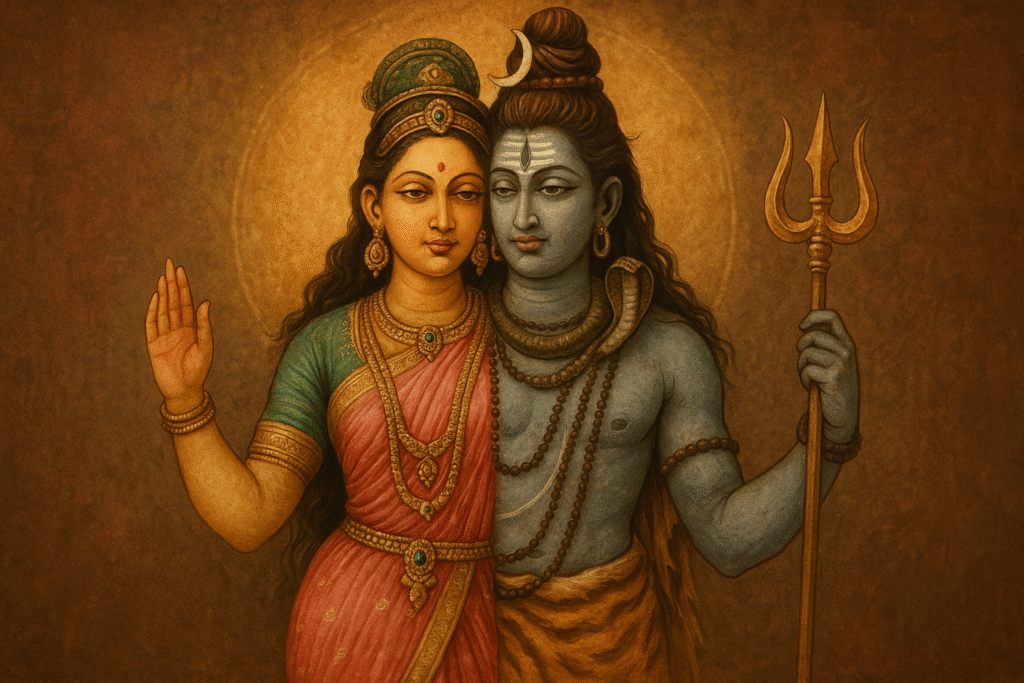
🌺 What Does Ardhanarishvara Mean?
The word Ardhanarishvara is a combination of three Sanskrit words:
Ardha – Half
Nari – Woman
Ishvara – Lord or God
So, Ardhanarishvara literally means “The Lord who is half woman” — a composite form of Shiva and Parvati (Shakti), split vertically down the middle, representing the divine unity of opposites.
📜 Mythological Story Behind Ardhanarishvara
💫 The Birth of Ardhanarishvara
According to the Shiva Purana and Linga Purana, once the gods and sages approached Brahma, asking how creation would continue without the presence of the feminine force. Brahma meditated upon Shiva, who appeared in the form of Ardhanarishvara — showing that creation happens only when Shiva (consciousness) and Shakti (energy) unite.
Later, Shiva separated his female half from himself, creating Goddess Parvati, who would go on to become his consort and the mother of creation.
🕉️ Symbolism and Spiritual Meaning (In Simple Words)
The form of Ardhanarishvara is not just a beautiful image — it teaches us something very deep about life and the universe.
In this form:
🔵 Left side is Parvati (Shakti) – This side shows the female energy. It stands for love, care, kindness, beauty, emotions, and the power to create life — like a mother does.
🔴 Right side is Shiva – This side shows the male energy. It stands for strength, wisdom, calmness, discipline, and the power to destroy bad things — like a protector or guide.
🌀 When these two sides come together, they show that:
Life is made of both soft and strong, heart and mind, care and courage.
Both man and woman have both energies inside them — we all need love and strength, emotion and wisdom.
To live a happy and complete life, we should balance both sides — not too strict, not too emotional, but just right.
So, Ardhanarishvara is a reminder that God is both male and female, and we, too, must respect and balance both energies in ourselves and others.
📚 Origin and Historical References
The concept of Ardhanarishvara is ancient and sacred, with deep roots in Hindu scriptures, especially the Puranas. It reflects a powerful spiritual truth — that the universe is born from the union of masculine and feminine energies, not from one alone.
Let’s look at how different Puranas and historical sources describe this unique form of Lord Shiva:
In the Puranas:
🔱 Shiva Purana
- The Shiva Purana tells us that Ardhanarishvara is the original form of Lord Shiva and Parvati — before they became two separate beings.
- In this Purana, it is said that Shiva and Shakti were one and the same in the beginning — inseparable. When creation had to begin, Shakti separated from Shiva, taking form as Parvati, so that life and the world could be created.
- Ardhanarishvara is thus the source of all existence, showing that nothing can be created without the union of male and female principles.
🔥 Linga Purana
- The Linga Purana emphasizes how Ardhanarishvara was manifested by Shiva to teach the world that Shakti (feminine power) is not separate from him — they are two sides of the same truth.
- It describes this form to show the inseparability of Purusha (spirit) and Prakriti (nature), or Shiva and Shakti. Without one, the other has no power to act.
🌌 Skanda Purana
- The Skanda Purana highlights the cosmic role of Ardhanarishvara.
- It explains how this form is not only about divine union, but also about balance and harmony in the cosmos.
- Worship of Ardhanarishvara is described as a way to align oneself with the natural rhythm of the universe — where both masculine and feminine energies must flow in unity.
- 🌺 Devi Bhagavata Purana
- In the Devi Bhagavata Purana, the female half of Ardhanarishvara is referred to as Adi Shakti, the primordial energy.
- This text highlights the creative force of the goddess, saying that even Shiva is powerless without Shakti.
- The Purana states: “Without Shakti, Shiva is like a lifeless corpse (Shava).” This reflects the powerful message of Ardhanarishvara — that Shiva and Shakti are incomplete without each other.
🏛️ Historical Depictions in Art and Culture
- The earliest visual representation of Ardhanarishvara can be traced back to Kushan-era sculptures (1st–3rd century CE).
- By the Gupta period (4th–6th century CE), the form became a popular icon in temple art across India.
- Temples like Chidambaram (Tamil Nadu), Ellora Caves (Maharashtra), and Khajuraho (Madhya Pradesh) have stunning stone carvings showing Ardhanarishvara with one half as Parvati (with breasts, sari, jewelry) and the other as Shiva (with tiger skin, trident, and jata or matted hair).
✨ Why Is Ardhanarishvara Important Today?
Ardhanarishvara reminds us that:
- True power lies in balance, not dominance.
- Every soul is a mix of Shiva and Shakti, logic and emotion, strength and compassion.
- Gender, in spiritual terms, is fluid — what matters is the energy we cultivate.
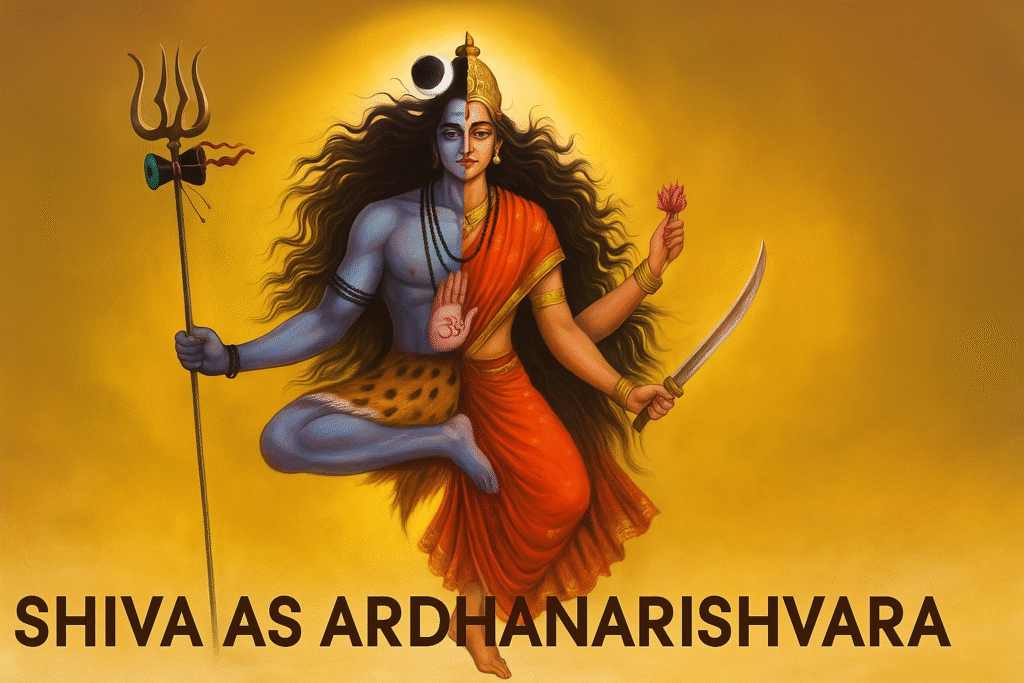
Ardhanarishvara is not just a form of Shiva—it is a philosophy of life. In a world often divided by gender, duality, and imbalance, this divine form shows the path of oneness and harmony.
As the great sages have said:
“Where there is Shiva, there is Shakti. Where there is Shakti, there is creation.”