
"Jagannath’s Incomplete Idol: A Complete Expression of Divinity"
Among India’s ancient temples, the Jagannath Temple of Puri stands out—not just for its spiritual significance but also for the mystery enshrined within its sanctum. The central deity, Lord Jagannath, appears unlike any other form of Lord Krishna or Vishnu. With large round eyes, a stubby form, and no visible hands or feet, Jagannath seems unfinished. Why? What’s the story behind this incomplete idol?
The Unfinished Idol: A Story Rooted in Devotion
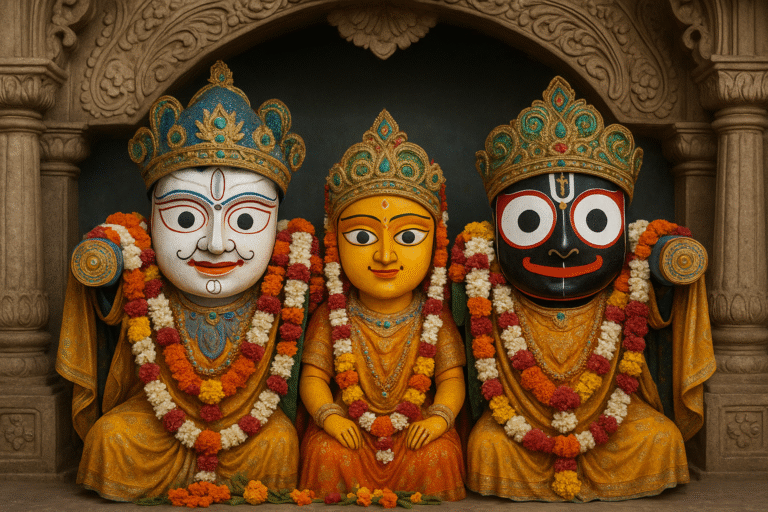
According to legend, the form we see today is deeply rooted in a divine promise and a test of faith. The story goes back to King Indradyumna, a devout worshipper of Lord Vishnu, who wished to create an idol of the Lord like none before.
Lord Vishnu appeared in the king’s dream and instructed him to retrieve a mystical log of wood (Daru Brahma) floating on the sea. The king found the sacred wood and was told that Lord Vishwakarma, the divine architect, would craft the idol—but only under one condition:
“You must not open the door or disturb me until the work is complete.”
The king agreed. Days passed. Weeks went by. Eventually, the queen grew worried, hearing no sound from within. Fearing something had gone wrong, the king broke his promise and opened the door—only to find the unfinished idols of Jagannath, Balabhadra, and Subhadra.
Divine Will Behind the Form
To the king’s dismay, the craftsman vanished. It was then revealed that the artisan was Lord Vishwakarma himself, and that the form—even though incomplete—was exactly as the Lord wished to be worshipped.
Thus, the “incomplete” form was complete in divine intent. Lord Jagannath chose this form as an expression of eternal love and accessibility, breaking away from the rigid iconography of classical idols.
Symbolism of the Form
The unique features of Jagannath carry rich meanings:
- No hands or feet: Represents universality—God is everywhere, beyond form and flesh.
- Large, round eyes: Ever watchful, ever compassionate, seeing all beings equally.
- Stump-like form: A message that God does not need limbs to protect, bless, or love his devotees.
Some also interpret this form as inclusive of all communities, beyond caste or ritual boundaries, where form doesn’t limit divine accessibility.
Conclusion: Incompleteness as a Form of Completeness
The story of Jagannath teaches us that divinity isn’t always about perfection in appearance. Sometimes, incompleteness is the highest form of spiritual expression. In this unique idol, devotees see not the absence of limbs, but the presence of limitless compassion.
So next time you gaze upon Jagannath’s wide eyes and armless form, remember: you’re looking at a God who transcended physical form to become eternal love itself.