
🌿 Why Tulsi is Not Offered to Lord Ganesha?
In Hindu tradition, Tulsi (Holy Basil) is one of the most sacred plants. It is considered a symbol of purity, health, and spiritual devotion. Tulsi leaves are offered to many gods, especially Vishnu and Krishna, as a form of respect and prayer. However, there is one major exception — Tulsi is never offered to Lord Ganesha.
Why is that so? What is the story behind this unusual rule in Hindu worship? Let’s explore the mythological and spiritual reasons behind this belief.
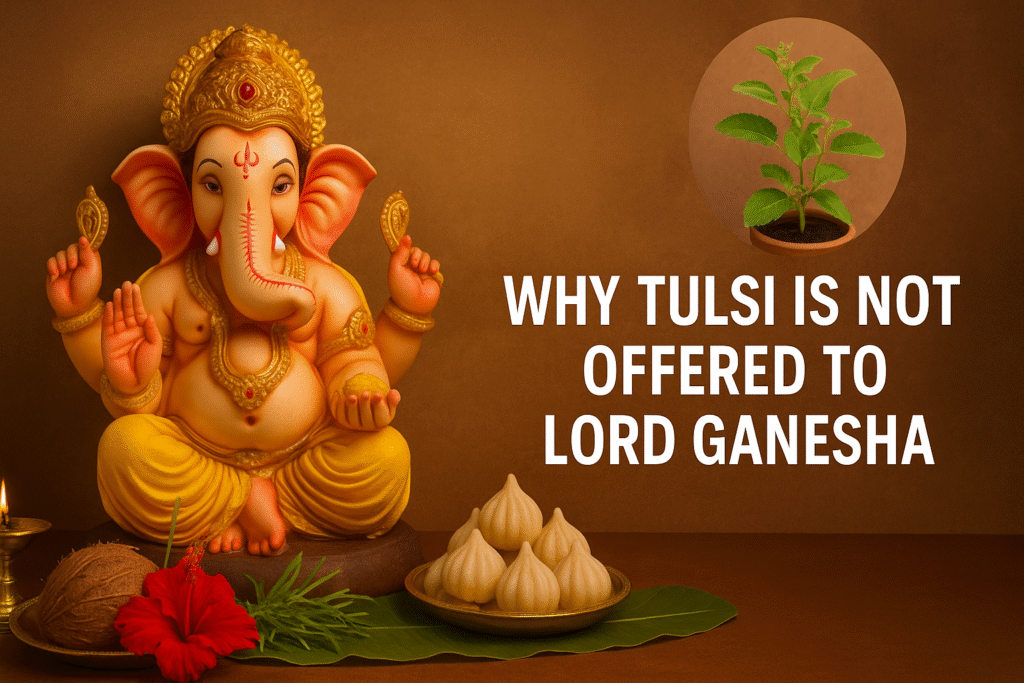
🌺 The Mythological Story Behind It
According to the Padma Purana, a popular Hindu scripture, the story goes like this:
Once upon a time, Tulsi Devi, a pious and devoted woman (incarnation of Vrinda), was walking along the banks of the Ganga River. There she saw Lord Ganesha, who was meditating peacefully. Tulsi was impressed by his divine charm and strong personality.
She approached Lord Ganesha and proposed marriage to him. But Ganesha, who had taken a vow of celibacy (brahmacharya), politely refused her proposal. Tulsi felt insulted and hurt. In her anger, she cursed Ganesha, saying, “You shall also get married against your will.”
Ganesha, shocked by the curse, became angry too and cursed Tulsi in return: “You shall be married to a demon (asura), and then be turned into a plant.”
As per the curse, Tulsi was later married to the demon Shankhachuda, and eventually transformed into the sacred Tulsi plant.
Since then, Tulsi is not offered to Ganesha, as their union was marked by disagreement and curses.
🙏 Spiritual & Symbolic Beliefs
Tulsi and Ganesha – Different Energies
- Tulsi is a very pure and sacred plant. She stands for devotion, love, and marriage. Tulsi is also connected to Goddess Lakshmi, the goddess of wealth and good fortune.
- On the other hand, Lord Ganesha is known for living a simple, peaceful, and unmarried life in many traditions. He represents detachment, which means staying away from desires and attachments.
So, offering Tulsi (a symbol of marriage) to Ganesha (who followed celibacy) doesn’t match spiritually. It’s like mixing two opposite ideas — marriage and renunciation. That’s why it is avoided.
💫 What About Riddhi and Siddhi?
- In some stories, Ganesha is said to have wives named Riddhi (prosperity) and Siddhi (success).
- But in many beliefs (especially in Ganapatya tradition, where Ganesha is the main god), he is seen as a brahmachari — someone who does not marry or have desires.
Even if some stories mention marriage, many rituals still honor his celibate form, and that’s why Tulsi is not offered to him.
📜 Historical and Cultural Influence
Over time, the Padma Purana story became a cultural norm. Priests and elders passed down the instruction that Tulsi should not be offered to Ganesha.
Even today, during Ganesh Chaturthi or daily worship, devotees offer durva grass (doob), flowers, modaks, and other items — but strictly not Tulsi leaves.
✅ What Should Be Offered to Lord Ganesha?
Instead of Tulsi, here are the traditional offerings:
- Durva Grass (very dear to Ganesha)
- Modak (sweet dumpling, his favorite)
- Banana Leaves
- Red Flowers, especially hibiscus
- Sandalwood Paste
- Coconut
🕉️ Final Reflection
The story of Tulsi and Ganesha is not just a tale of curse and consequence. It also teaches us about the balance of devotion, vows, and spiritual energy. In Hindu dharma, every ritual has a symbolic meaning, and even what we offer to deities is deeply rooted in mythology, culture, and spiritual alignment.
So, the next time you worship Lord Ganesha, remember the story of Tulsi and offer him with love, faith — but without the sacred Tulsi leaves.
📌 Did You Know?
- Tulsi is essential in Vishnu and Krishna worship but forbidden in Ganesha puja.
- Durva grass offered to Ganesha has three blades, representing Satva, Rajas, and Tamas — the three gunas.