
🌞 Chhath Puja – A Divine Bond with the Sun God
Chhath Puja is one of the oldest and most sacred festivals of India, deeply rooted in tradition and spirituality. It holds a special place in the hearts of people from Bihar, Jharkhand, eastern Uttar Pradesh, and even Nepal’s Terai region. Unlike many other Hindu festivals, Chhath is unique because it involves the worship of nature—specifically, the Sun God (Surya Dev) and his sister Chhathi Maiya, the goddess of purity and motherhood.

🌄 What is Chhath Puja?
Chhath Puja is a four-day long Hindu festival dedicated to Lord Surya (the Sun God) and his sister Chhathi Maiya. It is the only festival that celebrates both sunrise and sunset together, acknowledging the power of both.
Devotees perform rituals, take holy dips in rivers or ponds, fast without water (nirjala vrat), and offer Arghya (water offering) to the setting and rising sun. It symbolizes gratitude, purity, and prayer for life and fertility.
📜 History & Origin
Chhath Puja dates back to ancient Vedic times. It is believed that Draupadi and the Pandavas performed Chhath to regain their lost kingdom and overcome difficulties. Another legend says that Lord Rama and Sita observed the Chhath fast after returning from exile to Ayodhya.
The festival has deep Vedic roots where the worship of the sun was done through mantras, chants, and rituals without idols.
🌞 Mythological Beliefs
- Chhathi Maiya is believed to be the Goddess Usha, wife of Surya Dev. She is worshipped for the welfare of children and the health of family members.
- According to another myth, Karna, the son of Surya and Kunti, was a devout sun worshipper and used to stand in waist-deep water offering Arghya.
- It is believed that those who perform Chhath with full devotion are blessed with happiness, health, and children.
🙏 Rituals and Celebration
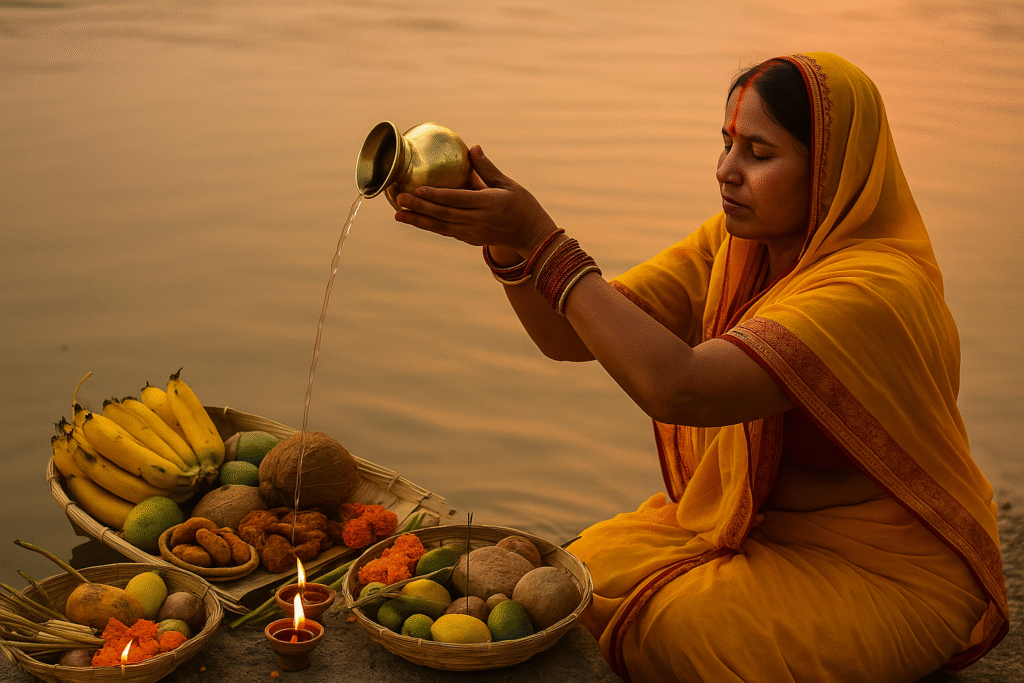
Chhath Puja is celebrated over four days, each with its spiritual significance:
- Nahay Khay (Day 1):
- Devotees clean their homes and surroundings.
- They take a holy dip and eat Satvik food like lauki-bhaat (bottle gourd with rice).
- The fast begins with pure and simple food.
- Kharna (Day 2):
- Devotees observe a fast the whole day.
- In the evening, they prepare kheer, puri, and fruits for prasad after offering it to Chhathi Maiya.
- After this meal, they begin a 36-hour nirjala fast (without water or food).
- Sandhya Arghya (Day 3):
- Women dress in traditional sarees (often yellow or red).
- Devotees go to rivers or ponds to offer Arghya to the setting sun.
- They sing folk songs and pray for the family’s health.
- Usha Arghya (Day 4):
- Before sunrise, devotees return to the water bodies to offer Arghya to the rising sun.
- After worship, they break their fast and distribute prasad.
🎶 Traditional Music & Folk Culture
Chhath Puja is incomplete without its heart-touching folk music, sung in local dialects like Bhojpuri, Maithili, and Magahi. These songs express love, devotion, and stories of Chhathi Maiya.
Popular songs include:
- “Kanch hi baans ke bahangiya”
- “Uga ho suruj dev”
- “Pahile pahil chhathi maiya…”
These songs are sung during preparation, rituals, and even in groups at ghats. The sound of dholak, tabla, and claps adds divine energy to the environment.
Why Prasad is Important in Chhath Puja:

- Symbol of Purity and Devotion:
- All items are made in a pure, clean, and holy environment, often by fasting devotees themselves.
- The preparation is a form of sacred service (seva) to the Sun God and Chhathi Maiya.
- Nature Worship:
- Prasad includes fruits, sugarcane, coconut, rice laddus, and thekua, all natural and eco-friendly.
- It reflects gratitude toward Mother Earth and nature’s bounty.
- Cultural Identity:
- Thekua, rice laddus, and seasonal fruits are traditional to Bhojpuri and Maithili culture.
- These items connect generations through shared rituals and recipes.
- Health and Simplicity:
- All ingredients are satvik (pure vegetarian)—no onion, garlic, or chemicals.
- The food is easy to digest after a long fast and spiritually energizing.
- Sharing Blessings:
- Prasad is distributed among family, friends, and neighbors as a blessing from the divine.
- It promotes unity, joy, and a sense of community.
- Offering of Gratitude:
- Each item in the soop (bamboo basket) is an offering of thanks for life, health, and prosperity.
- It reflects humility, respect, and connection with the divine.
🎭 Culture and Traditions
- Women wear bright sarees with sindoor covering the hairline till the nose.
- Families prepare thekua (sweet snack made of jaggery and flour) and fruits like banana, coconut, and sugarcane.
- All items are offered in soop and daura (bamboo baskets).
- The celebration is deeply rooted in cleanliness, discipline, and devotion.
- Ghats are beautifully decorated with lights, flowers, and rangolis.
🌞 Eternal Light of Chhath
Chhath Puja teaches us to:
- Respect nature and its cycles
- Be grateful for life and energy
- Embrace purity, faith, and patience
It is more than just a festival—it’s a soulful journey of love, sacrifice, and divine connection with the Sun and Mother Earth.
May Chhathi Maiya bless you with health, happiness, and harmony. Jai Chhathi Maiya! 🙏